 Rural Entrepreneurism We profile four rural entrepreneurs – Dave and Chris Shaw, and Wally and Heather Wilson – who are contributing to the health and quality of life of Montana's Hi-Line regional economy while fulfilling their personal dreams of independence and creativity. Their stories reveal lessons learned that are encouraging to all rural folks considering starting or growing their own business.
Information, Inspiration, and Ideas for a Sustainable Rural Future
Promoting the Entrepreneurial Community Spirit
The North American Rural Futures Institute
Rural News, Events and Trends in the 21st Century
Welcome
Welcome to NARFI, the North American Rural Futures Institute.
|
Montana's U.S. Senators Get |
|
Montana's Senator
|
Rural Entrepreneurism We profile four rural entrepreneurs – Dave and Chris Shaw, and Wally and Heather Wilson – who are contributing to the health and quality of life of Montana's Hi-Line regional economy while fulfilling their personal dreams of independence and creativity. Their stories reveal lessons learned that are encouraging to all rural folks considering starting or growing their own business. Regional Economics Leah Noel, NARFI Executive Assistant, recently attended Grassroots and Groundwork: Reducing Poverty and Rebuilding Communities Conference in St. Paul, Minnesota. On behalf of NARFI, Leah joined a group from north central Montana, from the Community Ventures Coalition, a newly funded NWAF agenda for poverty reduction.
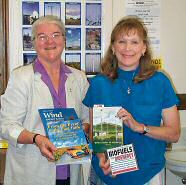 Emerging Technologies NARFI Director Timlynn Babitsky met recently with MSU-Northern Library Director Cynthia Harrison to contribute a bookshelf of books and a CD-ROM to bolster the university's information resources about renewable energy. MSU-N students, faculty, and citizens throughout northcentral Montana are encouraged to use these materials to envision and implement Montana's alternative energy future.
Rural Entrepreneurism Want to entice travelers off the Interstate to come spend money in your town? Here are three different projects that are doing just that in rural America. Click here for Make it clever and they WILL come.
 Rural Communities Craig Erickson of Bear Paw Development Corporation contributes his Future Thinker experience report after attending the 2004 Community Wind Energy Conference thanks, in part, to a NARFI mini-grant. Craig views this event from the perspective of a professional economic developer. Craig and Don Marble attended the conference on behalf of the Hi-Line.
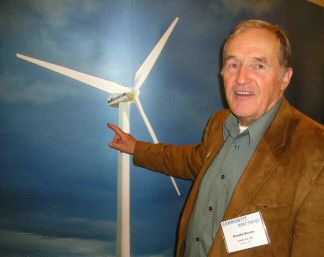 Rural Communities Read our latest Future Thinker experience report by Don Marble, Liberty County Commissioner. Don recently attended the 2004 Community Wind Energy Conference thanks to a NARFI mini-grant that helped Don meet the expense of attending this event on behalf of the Hi-Line.
Regional Economics There is a widely held perception that Rural Electric Cooperatives (REC) are generally not interested in pursuing renewable energy. On closer look, this does not appear to be true. Click here for the rest of the story.
Regional Economics $22.8 Million in Grants for Renewable Energy - Farm Bill 2004 Funding Announced. Applications must be postmarked no later than July 19, 2004. click here and also here for more information.
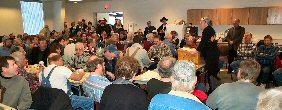 Emerging Technologies Over 250 people filled the community meeting room and spilled into nearby hallways of the Hill County Electric Co-op to attend the USDA Farm Bill Wind Power Workshop. Folks came to learn about an emerging renewable 'crop' to be harvested in northcentral Montana. This reprint of the Havre Daily News story is enhanced with NARFI photos and links to on-line versions of the presentations from the workshop.
Rural Entrepreneurism Eastern Ohio's Bruce Buren makes a decent living off of what most farmers dismiss as weeds and wasted land. Read this wild story!
Regional Economics We have come to believe that "out there somewhere" is the silver bullet that will fix whatever ails us. If only we can only find it, then our farm, school, town, region, economy -- future -- will be saved. Truth is, there ARE no silver bullets; there never have been. But that does not mean there isn't a way...click here to read more.
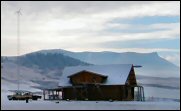 Rural Communities There's a beautiful log home under construction off-the-grid on the Rocky Boy's Reservation where Ted Demontiney and his family will be close to nature thanks to the power of the wind and the sun.
Rural Communities Do you want to know about the love life of chickens? About harvesting hay in Greenland? About self-discoveries while farming late in life? Celebrate life in rural places through images and stories offered here by rural folks across North America who love rural life despite its many challenges.Click here to start your journey.
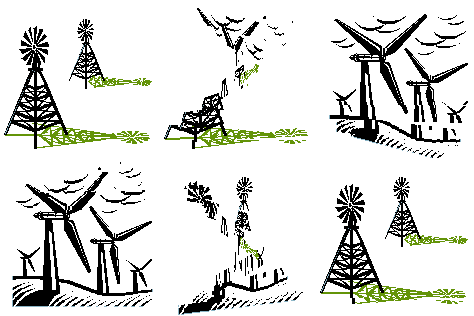 Emerging Technologies A number of Wind Power entries were recently added to the NARFI Rural Futures Directory. Especially interesting are the educational resources for teachers who want to add wind power topics to their curricula. To see the newest teachers' wind power resources visit this page.
Rural Communities Montanan Kate McMahon and community networking guru Andrew Cohill have sage advice for rural communities in Get Wired or Get Left Behind, their feature article from the July issue of Planning, the publication of the American Planning Association. [ Read article in PDF format ]
 Rural Entrepreneurism NARFI's Director Timlynn Babitsky and NARFI's Entrepreneur/Futurist In Residence, Jim Salmons, were among keynote presenters at Wired.org conference. Their presentation, Cross-Sector Partnerships: New Perspectives in Social Entrepreneurism, and a transcript of the associated discussion are now on-line.
 Microenterprise Networks
Introduction - Business Clusters In The Small
 Two of the hot topics today among regional and local economic developers are creative class and business cluster dynamics. In his award-winning book, The Rise of the Creative Class, Carnegie Mellon distinguished professor of regional economic development, Richard Florida, makes a compelling case for the counter-intuitive source of success factors in regional and local economies. Stuart Rosenfeld of Regional Technology Strategies (RTS), among others, champions the importance of recognizing business clusters, community ecosystems of associated businesses, as a dynamic source of regional and local economic well-being.
 In both these important areas, creative class and business clusters, the collective power of the small is validated and encouraged. And in both these domains of new economic development thinking, the power and importance of networking is recognized. We are, indeed, in a new era of the Network Society and its associated Network Economy.
Many who have read Dr. Florida's book are left with a feeling of, "Great, that is fascinating... and very urban. What about folks like me that live in small towns and rural areas? How do creative class dynamics affect me?"
These are important and timely questions. At NARFI and Sohodojo, we've already written a few pieces describing tROCCits, or the Rise Of Creative Class in the small. For more on the implications of creative class dynamics in rural and distressed urban communities, see our Iowa Creative Economy Unconference presentation, and more recently, Nanocorps in Micropolis.
Adding Business Cluster Spice to Creative Class Chili
While Florida's theory can open our eyes to social and personal dynamics that affect regional economies, we need to turn to the emerging domain of business clusters to reveal additional insights about how creative class folks like to do business. Sure, some creative classers do work and enjoy working for large megacorps doing creative work 'in the large'. But more and more we find creative individuals in small business, including creative self-employment.
Many 'creatives' have been rugged individualists all along. But modern communication technologies and modern transportation systems make it increasingly possible for more folks to make their living in creative enterprises wherever they choose to be.

|
|
| RTS Cluster Guru Stuart Rosenfeld |
|---|
Recognizing that the geographic isolation and rural nature of much of the state had a significant impact on the health of Montana's economy, Chief Business Officer Dave Gibson of the Montana Governor's Office of Economic Opportunity turned to business cluster guru Stuart Rosenfeld and RTS Inc. to conduct a significant study of Montana's existing and potential business clusters. The result of this exhaustive study was The Montana Business Clusters Study document. A 52-page summary of the Montana Business Cluster Study is available in MS-Word (.doc) format.
| NARFI's Creative Enterprise Cluster Agenda | |
|
The Creative Enterprise Cluster (CEC) represents 5% of the employed workforce in Montana. The CEC makes a significant contribution to the Montana economy. With the emerging Network Society and Network Economy, the contribution of the Creative Enterprise Cluster to Montana's economy is likely to grow and broaden. The CEC has the potential to invigorate local and regional economies in our rural and reservation communities. The North American Rural Futures Institute (NARFI) has an active and evolving Creative Enterprise Cluster research and social action agenda in collaboration with its strategic partners, Sohodojo and The Richard Florida Creativity Group. For details of NARFI's Creative Enterprise Cluster agenda, follow the above links to relevant sections of the NARFI Program Update. |
Rosenfeld's RTS study identified six clusters in Montana: the Wood-Based Product Cluster, Agri-Food Cluster, Experience Enterprise and Tourism Cluster, Life Sciences Cluster, Information Technology Cluster, and Creative Enterprise Cluster. The first five clusters are relatively conventional and expected given Montana's resource-based industries, agriculture, tourism and the ubiquitious reach of technology industries. It is the sixth cluster, the Creative Enterprise Cluster, that is especially interesting as an emerging 'new kid on the block' in cluster business analyses.
While geographic concentration is a primary feature of most business clusters, the Creative Enterprise Cluster transcends space – Who, What and Why are more important than Where and How Much. Shared interests defines the bond of community of the creative individuals and small businesses that comprise the Creative Enterprise Cluster. Once overlooked and dismissed as marginal contributors to local and regional economic vitality, creative researchers such as Richard Florida and Stuart Rosenfeld are shining a bright and constructive light on the self-employed and very small businesses that make up the Creative Enterprise Cluster.
The following is the chapter on the Creative Enterprise Cluster excerpted from the Summary of the Montana Business Cluster Study by Stuart Rosenfeld and the staff of RTS. While this analysis is specific to Montana, the concepts and insights are applicable to Creative Enterprises everywhere. Does your state have a Creative Enterprise Cluster analysis and action agenda?
Montana's Creative Enterprise Cluster Input/Output Diagram

Montana's Creative Enterprise Cluster
| "The creative centers tend to be the economic winners of our age." Richard Florida
The Rise of the Creative Class, 2002 |
Description
In Montana, the companies and individuals that produce and use creativity of form, design, sound, and language are the basis for the creative enterprise cluster. This cluster consists of all enterprises in the state whose principal competitive advantages are derived from distinctive appearance, form, or content.
 The cluster accounts
for more than four percent of the state
The cluster accounts
for more than four percent of the state
NARFI News The NARFI Program Update is now on-line in HTML and PDF formats. This is the most current and comprehensive document to date describing the NARFI mission, strategies, and tactics. NARFI-led projects as well as NARFI collaborations are detailed.
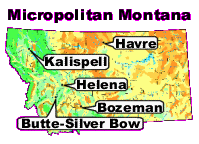 Regional Economics The U.S. Census Bureau sees the Network Society and its Network Economy coming. Learn more in Nanocorps in Micropolis: Small Is Good in the Network Economy, our latest article describing the collaborative NARFI and Sohodojo research agenda, and our evolving collaboration with The Richard Florida Creativity Group.
 Emerging Technologies NARFI sent recent MSU-Northern graduate, Kristie Smith of US Bank on the Montana Secretary of State's Energy fom the Farm Bus Tour to deepen our local community knowledge about wind power and biofuels. As our first mini-grant recipient, Kristie is spotlighted as a NARFI Futures Thinker. We invite you to read Kristie's trip report as she reflects on the whirlwind tour of alternative energy projects and applications in and around Montana.